Signed in as:
filler@godaddy.com

Do you find yourself replaying a conversation, checking something again, searching for certainty or asking someone to reassure you? Perhaps you feel calmer for a while, then a new doubt appears and the process starts again.
There may be a reason your mind keeps returning to the question. We can begin by understanding the pattern and what it is trying to protect you from.

OCD is diagnosed as one condition, but it can show up through different fears, doubts and compulsions. The examples above are not an exhaustive list. They include patterns I often encounter in therapy. While looking through them you may recognise more than one pattern.
An intrusive thought can happen to anyone. With OCD, unwanted thoughts, images or urges may keep returning and cause distress. A person may feel driven to do something to ease that distress, such as checking, seeking reassurance or going over things in their mind. The relief may be brief, and the doubt can return. When this pattern is taking up time or affecting daily life, an OCD assessment may help.

The fear or doubt may be different for each person, but the process can feel familiar. An unwanted thought appears, discomfort rises, and you feel you need to do something to settle it. That might be checking, asking for reassurance, avoiding something, or going over it again in your mind. You may feel better for a while, until the doubt returns.
Trigger → unwanted thought or doubt → discomfort → checking, rumination or reassurance → brief relief → doubt returns
Perhaps you can think of a recent moment that stayed on your mind.
* What set it off?
* What did you feel you needed to know or prevent?
* What did you do next, and how long did the relief last?
You do not need to find a perfect answer.
This is simply a way to notice the pattern, and cannot tell you whether you have OCD.

Most people experience thoughts they did not choose.
An intrusive thought may feel especially unsettling when it touches something you care deeply about, such as a relationship, your health or someone’s safety.
Sometimes the hardest part is what happens next
trying to work out why the thought appeared,
what it says about you,
or how to be completely certain that nothing bad will happen.
Checking and reassurance can also happen in your mind as well as through actions other people can see such as repeated checking, or private mental actions that nobody else sees.
Having an intrusive thought does not, by itself, mean you have OCD.

Children can have worries and routines as they grow. Sometimes, though, a worry feels so strong that a child believes they must check, repeat something or ask for reassurance before they can feel settled. The relief may last only a little while before the worry returns.
A child might repeatedly check their work, wash, arrange things, avoid certain situations or ask whether everything will be all right. Other responses may be harder to spot, such as silently counting, repeating words or going over a worry in their head. They may not know how to explain why they feel they have to do it.
If you are concerned, start with curiosity rather than correction. You could say, “I’ve noticed this seems difficult for you. Can you tell me what happens if you try not to do it?” Listen without asking them to justify the fear or abruptly stopping a routine that feels necessary to them. Repeated reassurance can become part of an OCD cycle, so parents can benefit from guidance on how to respond with warmth while helping their child move forward.
A GP can help you explore what is happening and whether an assessment is needed. Recommended treatment for children with OCD includes CBT with exposure and response prevention (ERP), adapted to the child’s age and involving parents or carers where appropriate.
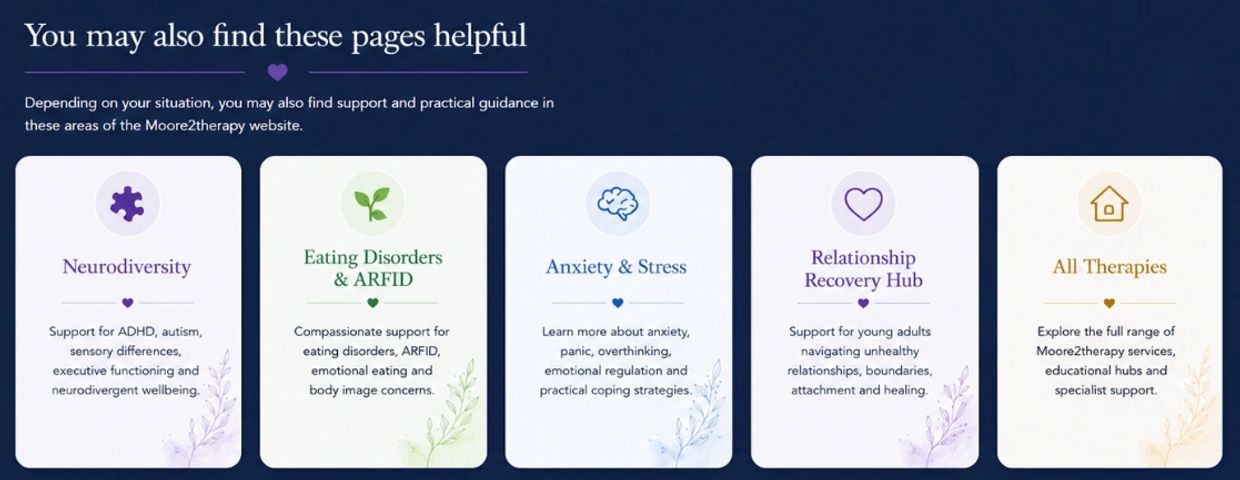
As you continue exploring the Moore2therapy website, you may also find these resources helpful. Many young people experience overlapping challenges, so it's common for anxiety, neurodiversity, confidence, eating difficulties and relationships to be connected.
You can continue exploring any of the related pages below to find information and support that's most relevant to you or your family.
Neurodiversity • Eating Disorders & ARFID • Anxiety & Stress • Relationship Recovery Hub • Individual Therapy • All Therapies